
How to Teach Major Scales Without Endless Memorization
Teaching major scales can feel like an uphill battle. Students often memorize one scale at a time, only to forget it a few weeks later because they never understand why each scale is built the way it is.
The good news? Every major scale follows the same pattern of whole and half steps. Once students recognize that pattern—and understand how key signatures fit into the picture—they can confidently build and play major scales in any key.
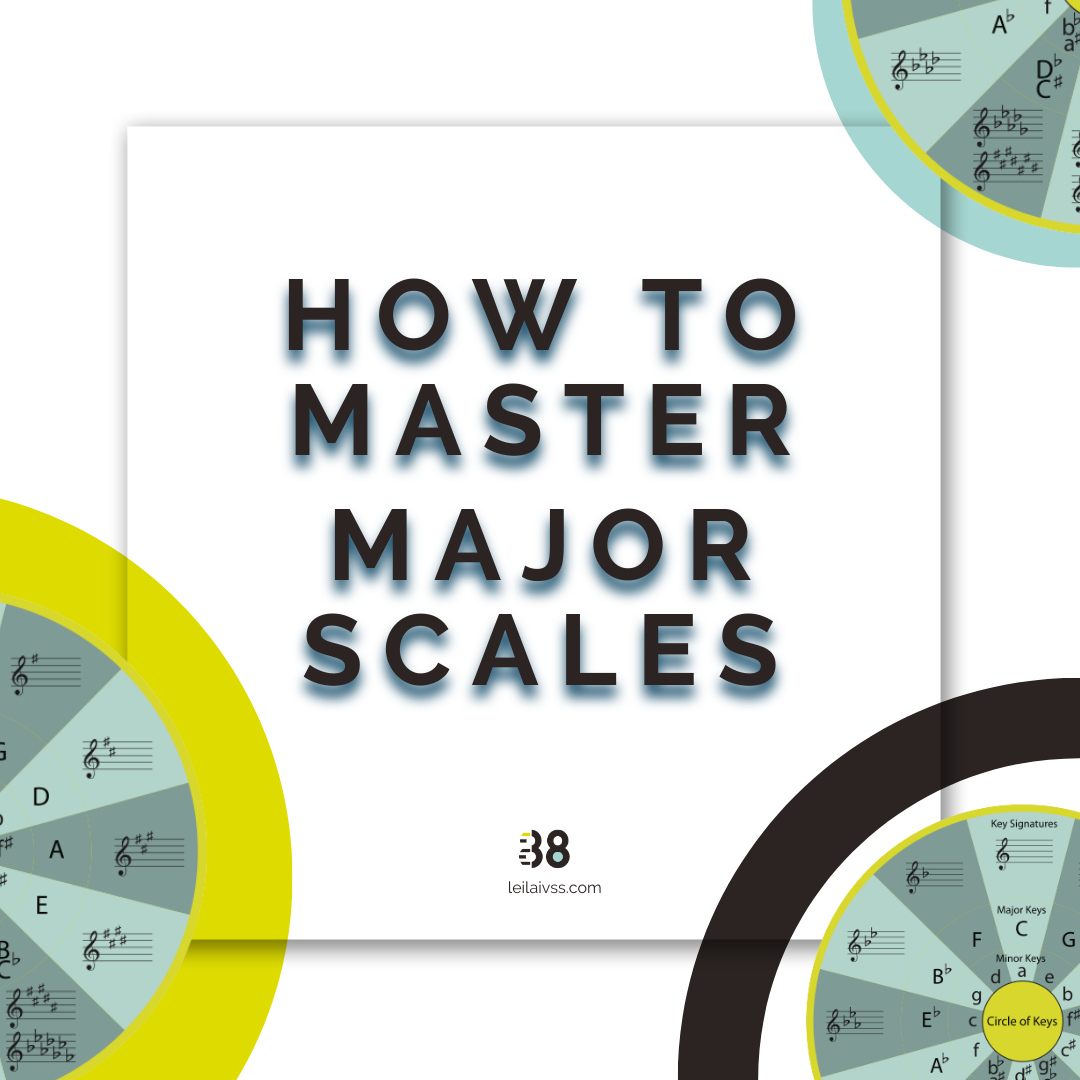
One of my favorite tools for teaching major scales is the Circle of Keys. It reveals the relationships between key signatures, scales, chords, and harmony in a visual, systematic way. Instead of memorizing isolated facts, students begin to recognize patterns that make music theory far more intuitive.
Before you dive in, be sure to download my FREE Circle of Keys printable to follow along with the examples below.
→ Get your FREE circle-of-keys printable HERE.
In the tutorial videos that follow, I'll show you how to use tetrachords and the Circle of Keys to master both major sharp and flat scales. Don't worry if you've never heard the word tetrachord—I'll explain everything step by step.
How to Master Major Scales and Their Key Signatures
As you watch the video, you may want to sit at a keyboard and play along!
Practice Hacks for Sharp Keys
Memorize the order of sharps by memorizing this silly sentence: FAT CATS GO DOWN ALLEYS EATING BANANAS.
As you construct a major scale using the Major Scale Code (34•78), notice how many sharps it has.
In B major, there are five sharps, so those sharps would be 1 = FAT 2 = CATS 3= GO 4 = DOWN 5 = ALLEYS
When viewing a key signature, a half step up from the LAST sharp is the key.
To find the relative minor of a major key, count three half steps down or find the 6th scale degree.
Sharp Major Scale Drills
A fantastic platform to customize drills is MusicTheory.net which has a companion app called Tenuto
Click on the links below and complete these exercises customized to drill major scales that require sharps on line or in the app.
How to Master Major Scales with Flats
Practice Hacks for FLAT Keys
Memorize the order of flats in this order BEAD (spells bead!) GCF (Greatest Common Factor)
As you play a major scale, notice how many flats it has.
When viewing a key signature, the second-to-last flat is the key.
To find the relative minor of a major key, count three half steps down or find the 6th scale degree.
Flat Major Scale Drills
Click on the links below and complete these exercises, customized to drill major scales that require flats.
Key Signature Identification Drill
Key Signature Construction Drill
If you're looking for a complete system for teaching scales, key signatures, and the Circle of Fifths together, keep reading. ↓
Ready to Make Scales Stick?
Learning scales shouldn't feel like a yearly battle of memorization.
Once students understand the patterns behind key signatures, scales become much easier to spell, play, and remember. The challenge is helping them move beyond reciting scales in order and develop instant recognition and true fluency in every key.
That's why I created Key 7.
Rather than drilling scales the same way every week, Key 7 includes games, activities, challenges, visuals, and creative exercises that help students:
Identify key signatures quickly
Connect scales to their relative minors
Understand how keys relate through the Circle of Fifths
Build confidence with scale spelling and fingering
Apply scale knowledge through improvisation and creative activities
My favorite part? Students stop relying on memorized routines and begin recognizing patterns.
Whether you're introducing scales for the first time or helping students finally master all 12 keys, Key 7 gives you practical tools you can use immediately in lessons, group classes, camps, and theory time.

Teaching key signatures doesn't have to mean endless drills and memorization.
Instead of asking students to memorize isolated facts, Key 7 encourages them to discover how scales, key signatures, chords, and harmony all work together.
How to Use These Ideas with Your Students
Dedicate a season (4-8 weeks) to mastering scales and their key signatures. Develop assignments for every level:
🎹 Beginners: Master the names of all sharps and flats, memorize the silly sentences, and let them know this will be useful down the road.
🎹 Elementary: Master the C, F, and G scales and their key signatures.
🎹 Intermediate: Master major tetrachords of sharp keys and their signatures. Then repeat with flat keys.
🎹 Late Intermediate: Master all major and minor scales and their key signatures.
As far as playing the scales, I assign them according to playing level in this order, AFTER five-finger patterns are mastered. Learn more about how I teach five-finger patterns in my course The Full Scoop on Chords.

Right hand only, two octaves.
Both hands, two octaves, hands alone.
Hands together two octaves.
Hands together in one, two, three, and four octaves following Bradley Sowash’s Squared Scales Routine.